

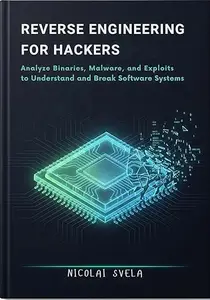
Free Download Reverse Engineering for Hackers: Analyze Binaries, Malware, and Exploits to Understand and Break Software Systems
by Nicolai Svela
English | 2025 | ASIN: B0GCJK9PNZ | 166 pages | pdf | 105 MB
Reverse Engineering for Hackers
Analyze Binaries, Malware, and Exploits to Understand and Break Software Systems
Reverse engineering is the skill of understanding software when you do not have its source code. In security, that skill matters because real attacks and real defenses often depend on binaries you cannot "just read" in an editor. Malware arrives as executables, proprietary applications ship without source, and vulnerabilities frequently hide inside compiled code paths that never show up in documentation. This book teaches you how to approach those binaries with discipline, method, and evidence, so you can explain what a program does, why it behaves that way, and what its security implications are.
You will learn reverse engineering the way professionals practice it. That means starting from fundamentals and steadily building toward real case work. You begin by learning how source code becomes a binary. A binary is the compiled machine code that a CPU executes directly, along with metadata that helps the operating system load it. You will understand the parts of a program that survive compilation, such as functions, control flow, strings, imports, and data structures, and you will learn how compilers transform high-level logic into instruction sequences you can recognize.
From there, the book takes you into the structure of executables and how they run in memory. You will learn how loaders map a program into memory, why the stack, heap, and code segments exist, and how binaries behave when symbols and debug information are missing. A symbol is a name that links machine code to human meaning, such as a function name or variable name. Many real targets are "stripped," meaning these names are removed. This book shows you how to recover meaning anyway by using patterns, cross-references, and runtime observation.
You then build a complete tool-based workflow for analysis. Static analysis is the process of understanding a program without executing it, typically by reading disassembly and decompiled output. Dynamic analysis is the process of observing a program while it runs, using debuggers and monitoring tools to confirm behavior. You will learn when to use each approach, how to combine them, and how to avoid common mistakes that cause analysts to misinterpret what they see.
A major focus of the book is learning to read and reason about assembly language. Assembly is a human-readable representation of CPU instructions. You will learn how calling conventions pass function arguments and return values, how stack frames represent local state, and how loops, conditionals, and function calls appear at the instruction level. You won't just memorize instructions. You will learn how to translate instruction sequences into clear program logic, which is the core skill behind reverse engineering and vulnerability research.
Decompilers are also covered in depth. A decompiler is a tool that attempts to reconstruct high-level pseudocode from machine code. Decompilers can be extremely helpful, but they can also mislead you when optimizations, obfuscation, or unusual code patterns are present. You will learn how decompilers work, where they fail, and how to validate decompiled output against real execution so your conclusions remain accurate.
eBook Details:
Title: Reverse Engineering for Hackers: Analyze Binaries, Malware, and Exploits to Understand and Break Software Systems
Author: Nicolai Svela
Language: English
Year: 2025
ASIN: B0GCJK9PNZ
Total pages: 166
Format: pdf
Size: 105 MB
Recommend Download Link Hight Speed | Please Say Thanks Keep Topic Live
Links are Interchangeable - Single Extraction