

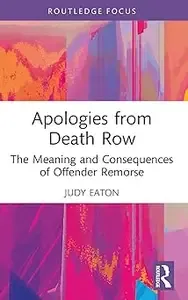
Judy Eaton, "Apologies from Death Row "
English | ISBN: 1032471816 | 2025 | 138 pages | PDF | 6 MB
Apologies from Death Row explores the notion of remorse, apologies, and forgiveness within the context of capital punishment in the United States, through the final words of offenders on death row, and the covictims' responses to them in their statements to the press after witnessing the execution.
The book demonstrates that there is evidence that some offenders on death row are truly remorseful and that some of the family members of their victims could benefit from this remorse, but that this is unlikely in the current system of capital punishment. Drawing from the fields of criminology, psychology, and sociology, the book begins with a theoretically informed introduction to the concepts of remorse and forgiveness, followed by an exploration of apology and forgiveness specifically in the context of capital punishment. It discusses how some initiatives within the criminal justice system, such as apology laws and restorative justice programmes, are being used to make it easier for offenders to apologize to their victims. Offenders on death row are considered, addressing why they might or might not apologize, and whether they are even capable of showing true remorse. The book then considers the family members of their victims ("covictims"), addressing whether they benefit from hearing the offender express remorse and witnessing the execution, and whether forgiveness is possible in this context. Evidence to support the arguments presented in the book come from the offenders' final words and the covictims' responses to them in their statements to the press. The book dispels two common myths about the death penalty. First, it shows that offenders on death row are not simply "monsters" who are incapable of understanding the severity of their crimes. Second, it provides evidence that, despite the popular belief that the death penalty is necessary in order to provide closure for the victims' family members, it may actually have the opposite effect. The family members' statements to the press after witnessing the execution contain more negative themes like anger and disappointment than positive themes like closure and peace. The book concludes with a discussion of the implications this has for systems of justice in general, and how a better understanding of the emotional state of offenders can help both victims and offenders.
Recommend Download Link Hight Speed | Please Say Thanks Keep Topic Live
Links are Interchangeable - Single Extraction