
0DAYDDL
Active member
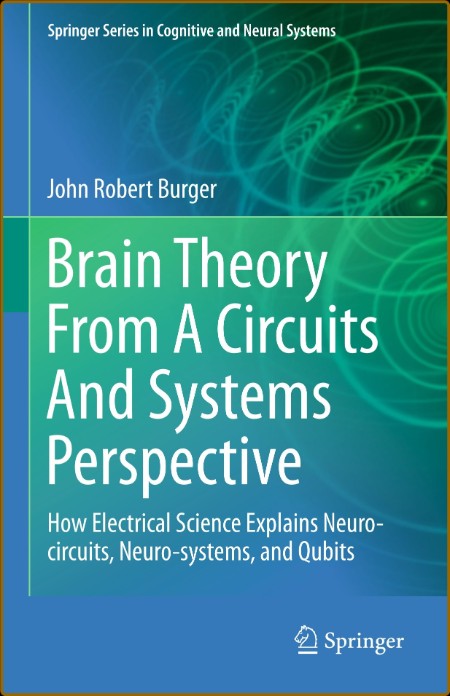
pdf | 4.17 MB | English | Isbn: B00D4LJSHS | Author: John Robert Burger | Year: 2013
Description:
This book models an idealized neuron as being driven by basic electrical elements, the goal being to systematically characterize the logical properties of neural pulses. In order to constitute a system, neurons as pulsating devices may be represented using novel circuit elements as delineated in this book. A plausible brain system is implied by the delineated elements and logically follows from known and likely properties of a neuron.
New to electrical science are novel pulse-related circuit elements involving recursive neurons. A recursive neuron, when properly excited, produces a self-sustaining pulse train that when sampled, provides a true output with a specified probability, and a false output with complementary probability. Because of its similarity to the qubits of quantum mechanics, the recursive pulsating neuron is termed a simulated qubit. Recursive neurons easily function as controlled toggle devices and so are capable of massively parallel calculations, this being a new dimension in brain functioning as described in this book.
Simulated qubits and their possibilities are compared to the qubits of quantum physics. Included in the book are suggested neural circuits for associative memory search via a randomized process of cue selection, and neural circuits for priority calculations. These serve to select returns from long term memory, which in turn determines one's next conscious thought or action based on past memorized experiences.
The book reports on proposals involving electron tunneling between synapses, and quantum computations within neurons. Although not a textbook, there are easy exercises at the ends of chapters, and in the appendix there are twelve simulation experiments concerning neurons.

Code:
https://rapidgator.net/file/6a89745316758f5b2c8675d7f0da6deb/
Code:
https://nitroflare.com/view/07B4D7FA3E8FB88/