

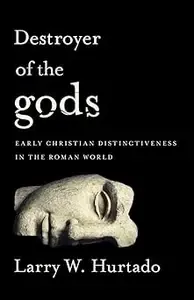
Larry W. Hurtado, "Destroyer of the gods: Early Christian Distinctiveness in the Roman World"
English | ISBN: 1481304739 | 2016 | 304 pages | MOBI | 607 KB
"Silly," "stupid," "irrational," "simple." "Wicked," "hateful," "obstinate," "anti-social." "Extravagant," "perverse." The Roman world rendered harsh judgments upon early Christianity―including branding Christianity "new." Novelty was no Roman religious virtue.
Nevertheless, as Larry W. Hurtado shows in Destroyer of the gods, Christianity thrived despite its new and distinctive features and opposition to them. Unlike nearly all other religious groups, Christianity utterly rejected the traditional gods of the Roman world. Christianity also offered a new and different kind of religious identity, one not based on ethnicity. Christianity was distinctively a "bookish" religion, with the production, copying, distribution, and reading of texts as central to its faith, even preferring a distinctive book-form, the codex. Christianity insisted that its adherents behave differently: unlike the simple ritual observances characteristic of the pagan religious environment, embracing Christian faith meant a behavioral transformation, with particular and novel ethical demands for men. Unquestionably, to the Roman world, Christianity was both new and different, and, to a good many, it threatened social and religious conventions of the day.
Recommend Download Link Hight Speed | Please Say Thanks Keep Topic Live
Links are Interchangeable - Single Extraction