

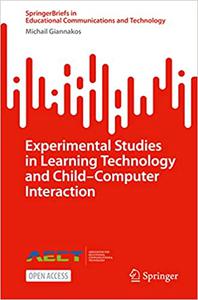
Experimental Studies in Learning Technology and Child-computer Interaction
English | 2022 | ISBN: 3031143493 | 120 Pages | PDF EPUB (True) | 19 MB
This book is about the ways in which experiments can be employed in the context of research on learning technologies and child-computer interaction (CCI). It is directed at researchers, supporting them to employ experimental studies while increasing their quality and rigor. The book provides a complete and comprehensive description on how to design, implement, and report experiments, with a focus on and examples from CCI and learning technology research. The topics covered include an introduction to CCI and learning technologies as interdisciplinary fields of research, how to design educational interfaces and visualizations that support experimental studies, the advantages and disadvantages of a variety of experiments, methodological decisions in designing and conducting experiments (e.g. devising hypotheses and selecting measures), and the reporting of results. As well, a brief introduction on how contemporary advances in data science, artificial intelligence, and sensor data have impacted learning technology and CCI research is presented. The book details three important issues that a learning technology and CCI researcher needs to be aware of: the importance of the context, ethical considerations, and working with children. The motivation behind and emphasis of this book is helping prospective CCI and learning technology researchers (a) to evaluate the circumstances that favor (or do not favor) the use of experiments, (b) to make the necessary methodological decisions about the type and features of the experiment, © to design the necessary "artifacts" (e.g., prototype systems, interfaces, materials, and procedures), (d) to operationalize and conduct experimental procedures to minimize potential bias, and (e) to report the results of their studies for successful dissemination in top-tier venues (such as journals and conferences).
Recommend Download Link Hight Speed | Please Say Thanks Keep Topic Live


Links are Interchangeable - No Password - Single Extraction