

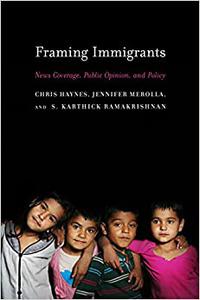
Chris Haynes, Jennifer Merolla, S. Karthick Ramakrishnan, "Framing Immigrants: News Coverage, Public Opinion, and Policy"
English | 2016 | pages: 301 | ISBN: 0871545330 | PDF | 2,1 mb
While undocumented immigration is controversial, the general public is largely unfamiliar with the particulars of immigration policy. Given that public opinion on the topic is malleable, to what extent do mass media shape the public debate on immigration? In Framing Immigrants, political scientists Chris Haynes, Jennifer Merolla, and Karthick Ramakrishnan explore how conservative, liberal, and mainstream news outlets frame and discuss undocumented immigrants. Drawing from original voter surveys, they show that how the media frames immigration has significant consequences for public opinion and has implications for the passage of new immigration policies.
The authors analyze media coverage of several key immigration policy issues-including mass deportations, comprehensive immigration reform, and measures focused on immigrant children, such as the DREAM Act-to chart how news sources across the ideological spectrum produce specific "frames" for the immigration debate. In the past few years, liberal and mainstream outlets have tended to frame immigrants lacking legal status as "undocumented" (rather than "illegal") and to approach the topic of legalization through human-interest stories, often mentioning children. Conservative outlets, on the other hand, tend to discuss legalization using impersonal statistics and invoking the rule of law. Yet, regardless of the media's ideological positions, the authors' surveys show that "negative" frames more strongly influence public support for different immigration policies than do positive frames. For instance, survey participants who were exposed to language portraying immigrants as law-breakers seeking "amnesty" tended to oppose legalization measures. At the same time, support for legalization was higher when participants were exposed to language referring to immigrants living in the United States for a decade or more.
Framing Immigrants shows that despite heated debates on immigration across the political aisle, the general public has yet to form a consistent position on undocumented immigrants. By analyzing how the media influences public opinion, this book provides a valuable resource for immigration advocates, policymakers, and researchers.
Recommend Download Link Hight Speed | Please Say Thanks Keep Topic Live
Download From UploadCloud
https://www.uploadcloud.pro/r6hhc15krs9q/rhi8h.F.I.N.C.P.O.a.P.rar.html
Download From NovaFile
https://nfile.cc/7QngE7lL/rhi8h.F.I.N.C.P.O.a.P.rar

https://rapidgator.net/file/bb58a0ea7622a4cf77efb38c9e039138/rhi8h.F.I.N.C.P.O.a.P.rar.html

https://nitroflare.com/view/783FEA8FEEB1AF8/rhi8h.F.I.N.C.P.O.a.P.rar

https://uploadgig.com/file/download/26904e6B53512310/rhi8h.F.I.N.C.P.O.a.P.rar
Links are Interchangeable - No Password - Single Extraction