

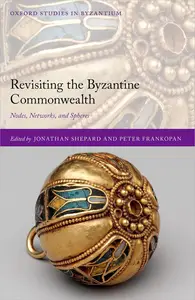
Free Download Revisiting the Byzantine Commonwealth: Nodes, Networks, and Spheres (Oxford Studies in Byzantium) edited by Jonathan Shepard, Peter Frankopan
English | October 13, 2025 | ISBN: 0198864094 | True EPUB/PDF | 768 pages | 45.4/144 MB
Pinning down Byzantium (or East Rome) is as difficult today as it was for contemporaries during its 1,000-year-long existence. Dimitri Obolensky sought to characterize its impact on Eastern Europe in his classic The Byzantine Commonwealth, focusing on the elements of religious doctrine, rites, and law which ruling elites there took from the emperor acting in tandem with the Constantinopolitan patriarchate.
Chapters in this volume, Revisiting the Byzantine Commonwealth, address such basic questions as who the Byzantines thought they were and how they managed to maintain their hegemonial stance for so long. Other chapters reappraise the uses of Byzantium to elites and also to other sectors of societies from the Upper Adriatic to the Volga. Surveys are offered of three spheres which functioned independently of (and in one case, expressly in antithesis to) Byzantium, yet which overlapped and were constantly interacting with it-the Latin west, the Islamic-Christian east, and the world of the steppes. Candidates for 'Commonwealth membership' can be found within these spheres, too, along with transregional networks which functioned regardless of political borders. Aspects of Byzantium appealed to the variegated societies and cultures around it in very different ways, with the imperial elite taking keen interest in neighbouring peoples and making the most of Soft Power as material resources dwindled from the thirteenth century on. Some periods of outsiders' engagement with the empire were short-lived, but others proved long-lasting, underpinned by ecclesiastical institutions and monastic networks.
The volume aims to foster a more rounded approach to the phenomenon of Byzantium, and a better understanding of how and why it impinges on so many Eurasian cultures and polities to this day.
Recommend Download Link Hight Speed | Please Say Thanks Keep Topic Live
Uploady
q50tf.7z
Rapidgator
q50tf.7z.html
DDownload
q50tf.7z
FreeDL
q50tf.7z.html
AlfaFile
q50tf.7z
FileServe
q50tf.7z.html
Links are Interchangeable - Single Extraction