

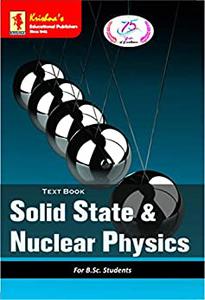
Solid State & Nuclear Physics by M.K. Tiwari
English | 2022 | ISBN: N/A | ASIN: B08YXMP2BS | 293 pages | PDF | 20 Mb
SYLLABUS- Solid State & Nuclear Physics, Unit-ICrystal Structure: Lattice translation vectors and lattice, Symmetry operations, Basis and Crystalstructure, Primitive Lattice cell, Two-dimensional lattice types, systems, Number of lattices, Pointgroups and plane groups, Three dimensional lattice types, Systems, Number of Lattices, Points groupsand space groups. Index system for crystal planes Miller indices, Simple crystal structures, NaCI, hcp,diamond, Cubic ZnS; and hexagonal , Occurrence of Nonideal crysal structures, random stacking ofpolyprism, glasses.
Crystal Diffraction and Reciprocal Lattice: Incident beam, Bragg law, Experimental diffractionmethod, Laue method, Rotating crystal method, Powder method, Derivation of scattered 'waveamplitude, Fourier analysis, Reciprocal lattice vectors, Diffraction conditions, Ewald method, Brillionzones, Reciprocal lattice to sc, bcc and face lattices, Fourier analysis of the basis and atomic form factor.Unit-II
Crystal Bindings: Crystal of inert gases, Van der Walls-London interaction, repulsive interaction,Equilibrium lattice constants, Cohesive energy, compressibility and bulk modulus, ionic crystal,Madelung energy, evaluation of Madelung constant, Covalent crystals, Hydrogen-bonded crystals,Atomic radii.
Lattice Vibrations: Lattice Heat capacity, Einstein model, Vibrations of monatomic lattice,derivation of dispersion relation, First brillouin zone, group velocity, continuum limit, Forceconstants, Lattice with two atoms per primitive cell, derivation of ispersion relation, Acoustic andoptical modes, Phonon momentum. Free electron theory, Fermi energy, density of states, Heatcapacity of electron gas, Paramagnetic susceptibility of conduction electrons, Hall effect in metals.Origin of band theory, Qualitative idea of Bloch theorem, Kronig-Penney model, Number of orbitalsin a band, conductor, Semi-conductor and insulators, Effective mass, Concept of holes.
Unit-III1. General Properties of Nucleus: Brief survey of general Properties of the Nucleus, Mass defectand binding energy, charges, Size, Spin and Magnetic moment, Bainbridge mass spectrograph.2. Nuclear Forces: Saturation phenomena and Exchange forces, Deutron ground state properties.3. Nuclear Models: Liquid drop model and Bethe Weiszacker mass formula, Single particle shellmodel (only the level scheme in the context of reproduction of magic numbers).4. Natural Radioactivity: Fundamental laws of radioactivity, Soddy-Fajan's displacement law andlaw of radioactive disintegration, Basic ideas about a, and decay.
Unit-IV1. Nuclear Reactions: Nuclear reactions and their conservation laws, Cross section of nuclearreactions, Theory of fission (Qualitative), Nuclear reactors and Nuclear fusion.2. Accelerators and detectors: Vande Graff, Cyclotron and Synchrotron, Interaction of chargedparticles and gamma rays with matter (qualitative), GM counter, Scintillation counter and neutrondetectors.
3. Elementary Particles: Basic classification based on rest mass, Spin and half life, particleinteractions (gravitational, Electromagnetic, week and strong Interactions).
Recommend Download Link Hight Speed | Please Say Thanks Keep Topic Live
Fikper
jx7c2.S.S..N.P.rar.html
Rapidgator
DOWNLOAD FROM RAPIDGATOR.NET
Nitroflare
DOWNLOAD FROM NITROFLARE.COM
Uploadgig
DOWNLOAD FROM UPLOADGIG.COM
Links are Interchangeable - No Password - Single Extraction